Transforming Complex Systems Through Mathematical Innovation
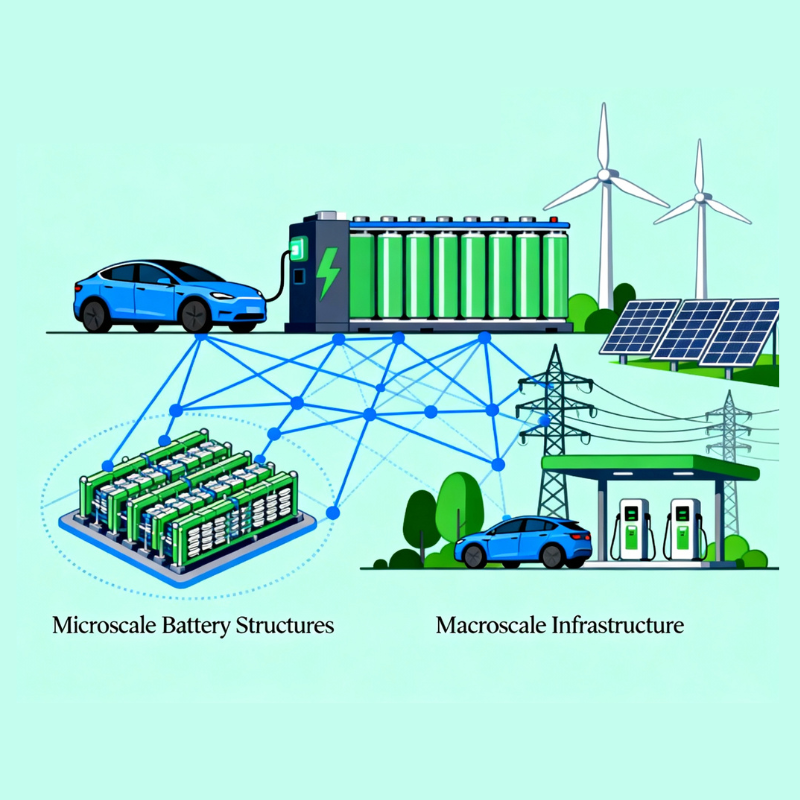
mSPACE addresses a fundamental challenge: how do intricate patterns emerge when small-scale interactions create large-scale behaviour? This COST Action brings together Europe’s finest mathematicians to tackle multiscale systems, from the microscopic world of battery materials to vast transportation networks.
Our purpose is straightforward: develop robust mathematical foundations for analysing systems where dynamics span multiple scales. We unite six established mathematical approaches, spectral geometry, gradient flows, stochastic analysis, network theory, discrete analysis, and optimal transport, to address practical challenges that matter.
Practical Applications: Enhanced battery technology supporting electric mobility, improved transportation network design, and meaningful contributions to Europe’s sustainability goals. Our interdisciplinary work connects pure mathematics with materials science, creating opportunities for genuine scientific progress.
European Collaboration: Four specialised working groups unite distinguished researchers across the continent, fostering knowledge exchange and collaborative discoveries that strengthen Europe’s position in mathematical sciences and sustainable technology development.
Six Mathematical Tools, One Powerful Solution
mSPACE combines spectral geometry, optimal transport, gradient flows, stochastic analysis, network theory, and discrete mathematics into a cohesive framework. This unified approach enables researchers to tackle challenges across multiple scales, from nanomaterial structures to continental transportation systems.
From Theory to Tangible Results
Our research directly advances battery efficiency for electric vehicles, optimises network infrastructure, and accelerates sustainable technology development. By bridging abstract mathematics with practical engineering, mSPACE delivers solutions that address Europe’s most pressing environmental and technological challenges.
European Research Excellence
Four specialised working groups connect distinguished researchers from diverse mathematical disciplines across European institutions. This collaborative network ensures knowledge transfer, promotes junior researcher development, and maintains Europe’s leadership position in computational and applied mathematics.
Multiscale Innovation
mSPACE reveals how tiny interactions create large-scale phenomena. Our research spans spatial, temporal, and stochastic dimensions—from atomic-level material properties to continent-wide system behaviour, providing insights essential for next-generation technology and scientific discovery.
Building Europe's Largest Mathematical Research Network
mSPACE represents one of Europe’s most ambitious mathematical collaborations, uniting distinguished researchers across multiple disciplines and countries. Our comprehensive four-year programme drives innovation through structured cooperation, targeted training, and strategic knowledge exchange.
Specialised working groups covering discrete systems, continuous spaces, structured dynamics, and materials science
Mathematical tools unified: spectral geometry, gradient flows, stochastic analysis, network theory, discrete analysis, and optimal transport
Target female representation, well above the European average of 20% in STEM fields
Annual focused innovative sessions bringing together 4-5 scientists from different working groups
Short-term scientific missions offered annually through twice-yearly calls
Nurturing Young Talent
2 Training Schools
Two comprehensive training schools in project years 2 and 3 specifically target students and young researchers. These schools promote cross-working group scientific exchange, provide networking opportunities, and include dedicated discussions on academic career pathways. The training programmes equip participants with essential skills in spectral geometry, gradient flows, stochastic analysis, and their practical applications in materials science and complex systems.
Building Collaborative Excellence
6 Major Workshops
Six strategically planned workshops throughout the project lifetime bring together all four working groups in joint collaboration. These intensive sessions unite researchers across discrete systems, continuous spaces, structured dynamics, and materials science applications. Each workshop is co-organised by two working groups, ensuring cross-disciplinary knowledge exchange and fostering innovative approaches to multiscale challenges.
Enhanced Learning Impact
These educational initiatives create a sustainable network of researchers equipped to tackle cutting-edge multiscale phenomena. By combining theoretical foundations with hands-on experience, participants develop the interdisciplinary expertise necessary for breakthrough innovations in battery technology, transportation optimization, and sustainable materials development.
Through strategic partnerships with industry stakeholders, government policy-makers, and startup incubators, the Action catalyses collaborations between European laboratories and green technology enterprises, translating theoretical breakthroughs into tangible societal benefits. Most significantly, mSPACE cultivates the next generation of European researchers through comprehensive training programmes, international mobility opportunities, and career development initiatives, securing Europe’s long-term scientific competitiveness whilst building sustainable networks that will continue advancing mathematical innovation long after the Action concludes. This approach ensures that mSPACE’s mathematical foundations will underpin Europe’s technological sovereignty, environmental sustainability, and research excellence for decades to come.